AI Leadership and Trust: Victor Cho on Amplifying People
By The Leadership Match
Victor Cho explores AI leadership, employee trust, and the fourth stakeholder: society. Learn why leaders should start by amplifying human potential.
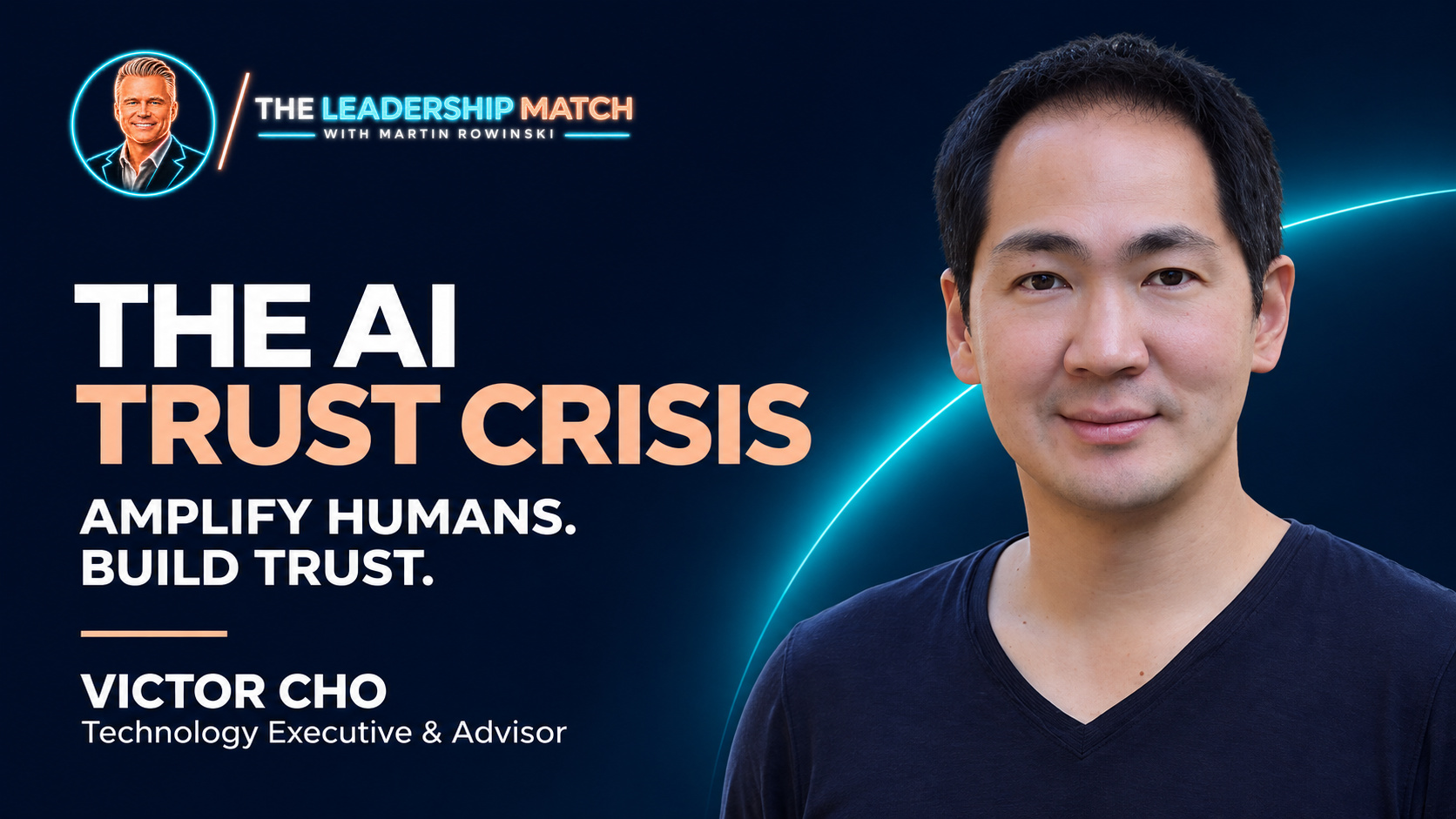
The AI Trust Crisis: Why Leaders Must Amplify Humans, Not Replace Them Victor Cho’s experiences at Microsoft and Intuit changed how he understood business leadership. His childhood taught him why those decisions matter personally. Together, they shape a question he wants executives to ask before pursuing AI-driven efficiency: What could this technology help our people accomplish? By Martin Rowinski Victor Cho began his career believing a CEO’s responsibility was to maximize shareholder return. Then he went to work at Microsoft. What stayed with him was the investment in employees. He saw a business creating an environment people wanted to work in and allowing them to participate in its success. Later, at Intuit, he developed a deeper appreciation for customer focus. His understanding of leadership expanded with each experience. Shareholders mattered. Employees mattered. Customers mattered. Eventually, he added a fourth stakeholder: society. That progression shaped our conversation on The Leadership Match. Victor, a technology executive whose career includes Microsoft, Intuit, Kodak, and Evite, discussed his work at Emovid, which he describes as a platform focused on verified human communication. We explored how AI is changing expectations around work, communication, and trust. But the most important point he made was about human choice. “The AI’s not telling us where we have to start.” AI creates possibilities. Leaders choose which ones to pursue, how to evaluate them, and whose interests deserve consideration. That choice is where AI leadership and trust begin. AI Leadership and Trust Begin With a Choice Victor has worked through several major technology shifts. He sees AI as another significant transformation, with substantial implications for how businesses operate. He also recognizes that jobs will change. His argument is about where leaders direct their attention first. A company can begin by asking which positions it might eliminate. It can also begin by examining what prevents its employees from doing better work. “We could also choose to amplify those folks, right? And let’s make them more efficient and more effective.” That second question opens a different conversation. Where do employees spend hours gathering information? Which customer problems remain unresolved because the team lacks capacity? What useful service has been too difficult or expensive to provide? The people doing the work often have specific answers. A customer service employee may need better access to relevant information. A manager may spend too much time preparing routine reports. A specialist may have ideas for improving the customer experience but little room to develop them. Starting there connects AI adoption to a meaningful outcome: helping people contribute more effectively. It does not guarantee that every role will remain unchanged. It does require leaders to investigate the opportunity to strengthen their workforce before assuming replacement is the best use of the technology. Where leaders begin sends a signal. Starting with employees’ obstacles gives them an opportunity to contribute to the change, while a discussion focused entirely on headcount can leave their knowledge and concerns outside the room. The Fourth Stakeholder Is Society Victor thinks about companies as organizations that live within society and leave a footprint. They employ people, serve customers, use resources, and influence behavior. Their effects extend beyond the people who buy their products or own their shares. A business can deliver something useful while also creating consequences it needs to address. Victor pointed to environmental effects and the influence of social platforms as examples of why leaders need that wider perspective. His fourth-stakeholder philosophy comes down to a straightforward expectation: “Let’s make sure that our corporations are also good citizens in the world that we’re creating.” That expectation belongs inside an AI strategy discussion. An initiative may offer lower costs or greater capacity. Leaders also need to consider how it affects employees, customer relationships, and the communities connected to the business. Those considerations do not remove difficult tradeoffs. They make the tradeoffs visible. For me, that is the value of Victor’s framework. It asks leaders to examine the consequences of a decision before treating one measure of success as the whole result. Why Empathy Is Personal for Victor Victor’s concern for employees comes from experience that predates his executive career. His parents divorced when he was young. His family faced financial hardship and, at one point, lost its home. Relatives took them in when they could not afford a place of their own. He remembers what that uncertainty felt like. During our conversation, he described his frustration with leaders who have experienced hardship themselves but become detached from what difficult decisions mean for others. “They forgot how hard life is for the average person.” An executive may have the resources to weather a long period without work. An employee affected by a job loss may have far less room to absorb it. The same business decision can therefore create very different personal consequences. Victor wants leaders to account for that difference. He challenged the idea that providing notice automatically resolves the human impact of a layoff. Empathy should influence preparation, communication, and support. It should also influence the questions asked before the decision is final. What alternatives were considered? What transition is realistic? What support will people need? The people affected may have far less financial security than the executives making the decision. Recognizing that difference should shape how leaders act. AI Is Changing What People Need From Communication Victor’s work at Emovid focuses on verified human communication. In the episode, he described a distinction between transactional and relational exchanges. Scheduling our podcast was his example of a transaction. If automated assistants help two people agree on a time, the important outcome may simply be an accurate appointment. Neither person necessarily needs to write every scheduling message personally. Other exchanges carry a different expectation. A leader explaining a difficult decision, a customer seeking reassurance, or an employee receiving an unusual request may need confidence about who is speaking and who stands behind the message. That is where Victor sees a growing need for trusted, relational communication. The distinction is useful because it asks leaders to consider the purpose of the interaction. Where does automation remove unnecessary work? Where does direct involvement matter? When should recipients know that assistance was used? Who remains accountable for the content? Those questions deserve explicit answers. Otherwise, employees and customers are left to make their own assumptions about what a message represents. Authenticity and Accountability Are Different Questions During our conversation, Victor described an impersonation incident involving a business customer. I shared a more familiar example from my own experience: employees contacting me to ask whether I had really requested that they buy gift cards. I had not. The request appeared to represent my instructions. That did not make it legitimate. This is an important distinction for leaders thinking about AI and trust. A convincing message still leaves questions about its source, authorization, and accuracy. Victor presented Emovid as his approach to addressing confidence in human communication. The broader leadership issue extends beyond any individual platform. People need to understand which channels and procedures their organization relies on, particularly for sensitive requests. They also need permission to question something unusual without feeling that they are challenging the authority of the person apparently sending it. Trust should make it easier to ask, “Did you authorize this?” A culture that discourages that question can leave people uncertain at precisely the moment they need clarity. Four Questions for a Better AI Business Strategy Victor offered a framework that moves the discussion beyond a narrow focus on efficiency. He organizes AI opportunities into four categories: cheaper, faster, better, and previously impossible. The first two are familiar. He believes the third and fourth deserve more attention. 1. What Can We Make Less Expensive? Where does the organization consume resources without producing enough value? This is a legitimate business question. It becomes limiting when every AI initiative is evaluated only through potential savings. 2. What Can We Make Faster? Where do employees or customers encounter unnecessary delays? Which processes take longer than their purpose requires? Speed needs a useful destination. Completing a task sooner matters when it improves the overall result. 3. What Can We Make Substantially Better? Victor’s third question focuses on the offering itself: “How can we use this technology to fundamentally improve our products and our services in a way that would have been incredibly difficult, maybe cost prohibitive before?” Most businesses have encountered customer needs they could not economically meet. Those constraints are worth revisiting. An idea previously set aside may now deserve a focused test. The test should establish whether the experience improves for the customer, including its quality, reliability, and usefulness. 4. What Previously Impossible Approach Should We Explore? Victor calls the final category the “impossible quadrant.” It asks leaders to temporarily set aside their current business model and consider approaches they previously dismissed. Could a competitor meet the same customer need in a fundamentally different way? Could your own organization deliver something it could not previously offer? “You need to spend energy thinking about what’s impossible.” The purpose is to challenge assumptions before they become blind spots. A leadership team does not need to chase every possibility. It does need room to investigate ideas that do not fit neatly inside its existing operations. The Communication Gap Is a Leadership Agenda When I asked Victor for one action leaders could take that week to build trust, he returned to communication. “For me, trust all comes down to transparent, open, honest communication.” He immediately acknowledged that this remains something he works on. “Am I communicating enough? Probably not.” That admission makes the advice more useful. Leaders can believe they have explained a decision clearly because they have discussed it repeatedly with a small group. Employees elsewhere in the organization may have heard very little. Customers may experience a change without understanding why it happened. Board members may receive a progress update without hearing the concerns emerging from the people implementing it. Victor’s recommendation was to take an inventory. When was the last meaningful contact with each stakeholder group? What might those people be worried about? What concern has leadership failed to address proactively? The gap is an agenda for your next conversation. An update does not require pretending to have every answer. It can explain what has been decided, what remains uncertain, and when people can expect to hear more. Repetition matters, too. A message delivered is not necessarily a message understood. Choose What the Technology Will Serve Victor’s career taught him to consider employees and customers alongside shareholders. His early life taught him to remember how consequential a business decision can be for someone with little financial security. His fourth-stakeholder philosophy brings those lessons into the AI conversation. For me, the connection is clear. Leadership requires deciding what the technology should help the organization accomplish and taking responsibility for how that choice affects people. Lower costs may be part of the answer. So may better service, stronger employee capabilities, and opportunities the business could not previously pursue. Three actions follow from the conversation. Review one AI initiative through all four stakeholder groups: employees, customers, shareholders, and society. Name whose perspective is missing from the discussion. Ask employees where better support would improve their work, and define what improvement looks like before introducing a tool. Then close one communication gap. Pick a stakeholder group, identify a concern leadership has not addressed, and provide a candid update. Before approving the next initiative, ask what it will help people do better, who will be affected, and what those people need to understand before the organization moves forward. Those questions give trust a place in the strategy from the beginning. Watch “AI Trust Crisis: Why Leaders Must Amplify Humans, Not Replace Them” with Victor Cho on The Leadership Match with Martin Rowinski. Frequently Asked Questions What does Victor Cho mean by the fourth stakeholder? He identifies society as a stakeholder alongside employees, customers, and shareholders. His framework asks companies to consider their broader impact and act responsibly within the communities they affect. What does it mean for AI to amplify employees? It means using technology to help people work more effectively, improve quality, or address needs they previously lacked the capacity to meet. Victor recommends exploring those opportunities as a starting point for AI adoption. What are Victor Cho’s four AI strategy questions? His framework asks how AI can make work cheaper, make it faster, improve products and services, and enable approaches previously considered impossible. How can leaders build trust during AI-driven change? Communicate openly about decisions and uncertainties, address stakeholder concerns proactively, clarify accountability, and check understanding. Trust also depends on following through after the message is delivered.
All articles