How Leadership Behavior Drives Team Performance | Leon Morales
By The Leadership Match
Learn how leadership behavior shapes team performance. Leon Morales shares lessons on individual feedback, complementary strengths, and self-awareness.
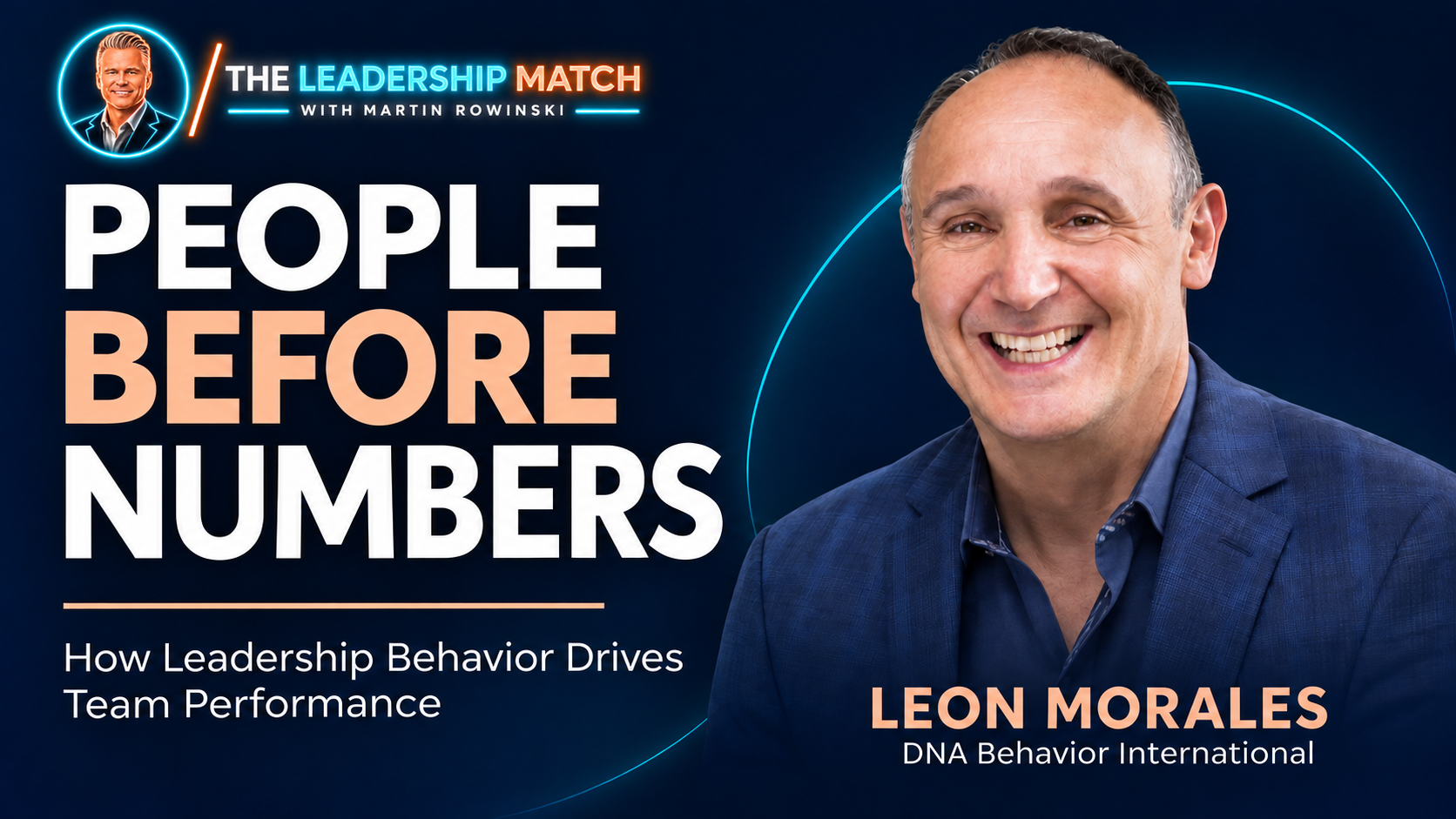
How Leadership Behavior Drives Team Performance: Lessons from Leon Morales By Martin Rowinski | The Leadership Match When a team misses a target, leaders usually start with the numbers. They review productivity, timelines, budgets, and results. Those measures tell us where performance fell short. Understanding why requires a closer look at the people doing the work—and the leadership decisions shaping their experience. In my conversation with Leon Morales on The Leadership Match, we explored the connection between leadership behavior and team performance: how people approach assignments, why individual feedback matters, and what happens when a leader’s own tendencies go unexamined. Introduced in the episode as president and chief energy officer at DNA Behavior International, Leon brings experience spanning the Air Force, Blockbuster, and 17 years at Cox Communications. Across those environments, he developed an approach grounded in a simple principle: people before numbers. That principle has practical implications. It asks leaders to understand how individuals work, build teams with complementary strengths, and examine their own contribution to the outcomes they expect. What Is the Connection Between Leadership Behavior and Team Performance? Leadership behavior is visible in everyday decisions: who receives an assignment, how expectations are communicated, what feedback sounds like, and how a manager responds when someone needs help. Those choices create the conditions in which people perform. A highly structured employee may bring precision and consistency to a complex process. A creative colleague may excel at exploring possibilities before a clear path exists. Someone who draws heavily on prior experience may need examples and context before approaching an unfamiliar assignment. Leon described how he looks for the traits that distinguish each person: “I tend to hone in on one or two of their behavioral traits that stand out to the rest of the team.” The practical question for a leader becomes: What does this person need to contribute effectively to this assignment? That question is more useful than assuming everyone should approach the same work in the same way. It also invites a more careful diagnosis when performance slips. A missed expectation may reflect a skill gap, an unclear brief, insufficient support, or a mismatch between the work and how someone has been prepared to do it. Understanding behavior gives leaders another lens through which to investigate. Use Structure to Make Good Work Easier Leon’s interest in behavior developed early in his military career. He joined the Air Force after high school, motivated by the opportunity to attend college through the GI Bill. Once there, he found himself studying how instructors influenced behavior and how the organization developed its people. He also benefited from officers who took an active interest in his leadership development. The experience left him with an appreciation for structure: clear responsibilities, a chain of command, and a system people could understand. For business leaders, the useful lesson is to make work easier to navigate. Employees should know what they own, where decisions sit, and when an issue requires escalation. Consider a project involving sales, operations, and product development. Everyone may be working hard, yet progress can stall if nobody knows who has final authority over scope changes. Additional effort will not resolve an ownership problem. Before asking a team to move faster, leaders should clarify: - What outcome are we working toward? - Who owns each decision? - What can the team resolve independently? - When should a concern be escalated? - How will we recognize that the work is complete? Structure becomes valuable when it helps people coordinate their contributions. Match Assignments to Strengths—and Provide Room to Grow Leon described giving structured employees work that benefits from their organization, creative employees opportunities to create, and experience-oriented employees assignments where their existing knowledge provides a useful foundation. The insight is straightforward: leaders should make thoughtful decisions about how work is assigned. There is also an important distinction between recognizing a preference and treating it as a permanent limit. A person who prefers familiar processes can still learn to handle ambiguity. A creative employee can develop operational discipline. The level of support may need to change. A practical application of Leon’s approach is to consider three things before assigning work: The task’s demands. Does success depend primarily on exploration, precision, coordination, implementation, or some combination? The employee’s demonstrated strengths. Where have they already shown good judgment and consistent contribution? The support needed for development. Would a template, an experienced partner, a smaller first assignment, or more frequent check-ins help them succeed? For example, giving someone an unfamiliar project with no context may create avoidable confusion. Providing a sample deliverable and clear decision boundaries can give that same employee a workable starting point. Thoughtful assignment design helps leaders use existing strengths while creating opportunities to build new ones. Make Feedback Specific to the Individual One of the clearest points in our conversation concerned feedback. “It should be individual in nature, especially your span of control.” Leon emphasized the value of one-on-one attention and helping employees recognize strengths they may not see in themselves. Generic feedback rarely gives someone enough information to act. “Be more proactive” leaves the employee to guess what should change. “Bring your recommendation and the main trade-off to our next project meeting” describes an observable behavior. The same principle applies to recognition. Telling someone they did a good job is encouraging. Explaining that their careful handoff prevented confusion helps them understand which contribution mattered. A useful feedback conversation connects three elements: - Observation: What did the person actually do? - Impact: How did it affect the work or the team? - Next step: What should they repeat, adjust, or practice? Individual feedback also requires listening. A manager may interpret silence as disengagement when the employee is still processing information or lacks context. Asking how the person approached the situation can reveal something a quick judgment would miss. Pair Complementary Strengths to Improve Execution Leon offered a concrete example of the gap between creating an idea and implementing it. A creative employee may develop a promising product or feature. Moving it into the business can require a different set of capabilities: understanding workflows, coordinating responsibilities, and anticipating operational consequences. As Leon put it: “You have to pair that person with somebody that really does understand it.” This is a useful way to think about team performance. Some work improves when people with different strengths share responsibility for moving it forward. Imagine a team developing a new customer onboarding experience. One person may be particularly good at imagining a better journey. Another may understand the systems, staffing, and handoffs required to deliver it consistently. Bringing them together early allows the idea and its implementation to develop alongside each other. Waiting until the concept is “finished” can leave operational questions unresolved until late in the process. Leaders can support this collaboration by defining the shared outcome, making each person’s contribution explicit, and giving them regular opportunities to test assumptions together. Psychological Safety Needs Practical Attention When I asked Leon about psychological safety, his answer was direct: “Oh, it literally can make or break organizations.” He then focused on whether teams recognize and use different talents, particularly when creative work needs to become an operational reality. That example raises a practical leadership question: Can people acknowledge where they need help without feeling that they have failed? A leader can make that conversation easier by asking employees what they need to deliver, where they see obstacles, and whose expertise would strengthen the work. Pairing complementary strengths can support that effort, but it does not by itself establish psychological safety. Leaders also need to pay attention to their response when someone raises a concern, challenges an assumption, or admits uncertainty. A useful place to start is the next team meeting. When someone identifies a problem, does the discussion become a search for understanding and a responsible next step? Or does the person learn that speaking up carries an unnecessary personal cost? Leadership Self-Awareness Begins with Your Own Behavior Perhaps the most revealing moment in our conversation came when Leon reflected on leaving Cox Communications. He described spontaneity and risk-taking as two of his strongest behavioral tendencies. Looking back, he believed those tendencies influenced the way he announced his departure. “I went in and probably just dropped the bomb on our leadership and without really having a plan.” Leon was clear that he had been treated well and maintained strong relationships. His regret concerned how he handled the transition. That distinction matters. A leader can stand by a decision while recognizing that its delivery could have been more thoughtful. The broader lesson is that a strength can carry a cost when it operates without reflection. Decisiveness can become abruptness. Thoroughness can delay action. Confidence can make it harder to hear another perspective. Before a consequential decision, leaders can pause to ask: - Am I responding to the situation or following a familiar impulse? - Who will be affected by how I communicate this? - What preparation would make the transition more respectful and effective? - Who could help me see a consequence I have overlooked? Self-awareness becomes useful when it changes what a leader does next. Put People Before Numbers in Everyday Management My conversation with Leon made “people before numbers” concrete. It shows up in how leaders assign work, provide feedback, combine strengths, and take responsibility for their own behavior. The starting point does not have to be a company-wide initiative. Choose one assignment and clarify the support it requires. Use one feedback conversation to identify a specific strength. Bring two colleagues with complementary capabilities together earlier in a project. Revisit a recent decision and consider how your own tendencies shaped its delivery. These are practical ways to examine the relationship between leadership behavior and team performance. The next time a result falls short, study the numbers—and then look closely at the conditions in which people were expected to produce them. Watch or listen to Leon Morales’s conversation on The Leadership Match for more on behavior, leadership, and the people behind performance.
All articles