Jim Keyes on Leadership: Choose a Direction, Keep Learning
By The Leadership Match
Former 7-Eleven and Blockbuster CEO Jim Keyes shares how curiosity, education, and a willingness to change direction shaped his approach to leadership.
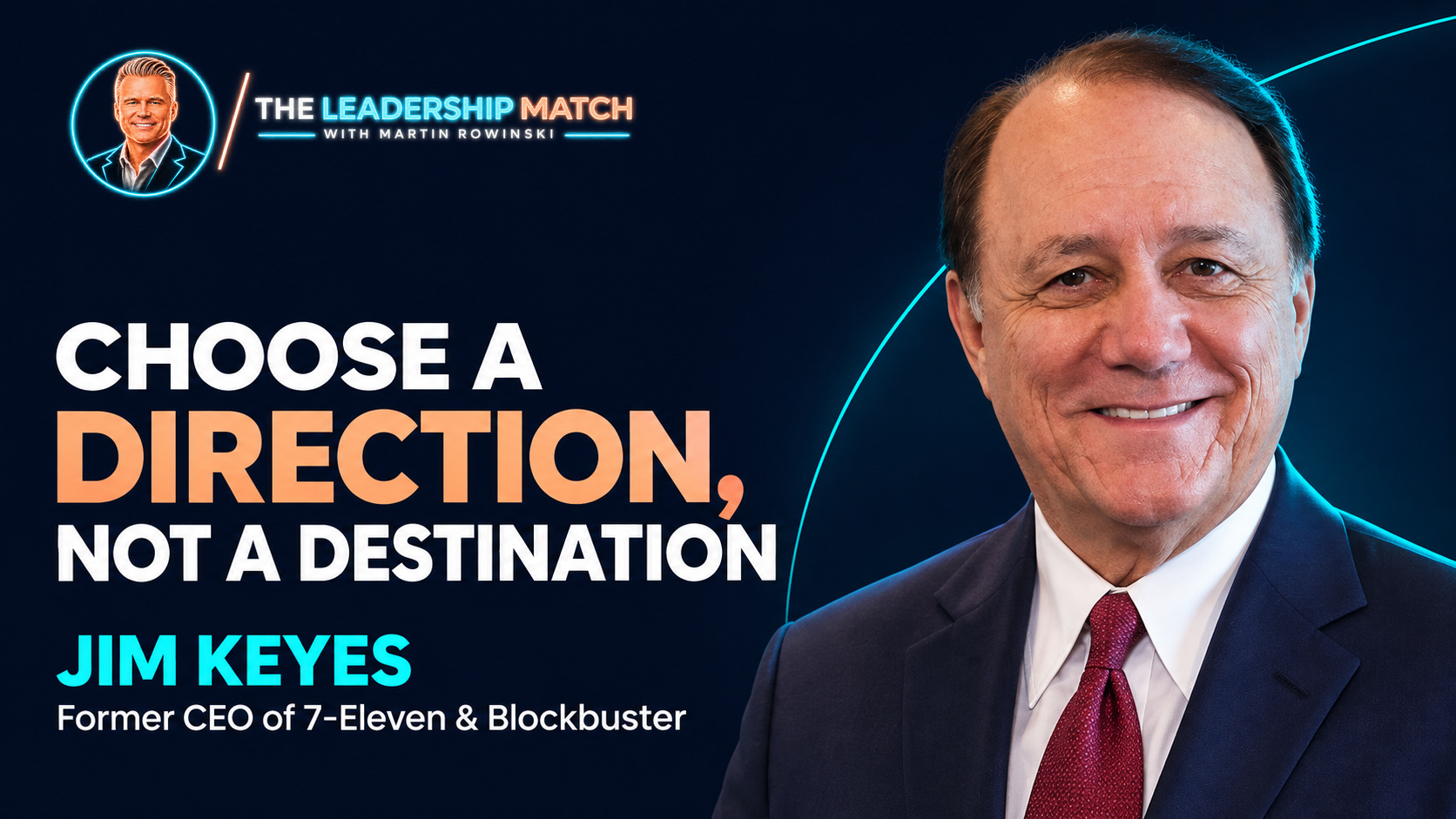
Choose a Direction, Not a Destination: Leadership Lessons from Jim Keyes A teenager repairing an old sports car could not have predicted he would lead 7-Eleven and Blockbuster. Jim Keyes’s story shows how learning can expand the opportunities you recognize and prepare you to change course. By Martin Rowinski Before Jim Keyes was the CEO of 7-Eleven or Blockbuster, he was a teenager trying to keep an old Triumph TR6 running. He did not have much money. He discovered that a sports car could become affordable if he learned to repair it himself. His days were full. Baseball, football, theater, student government, college applications in the library. In between, he worked at McDonald’s, running a night shift while still in high school. There was plenty of ambition. There was no clear picture of where it would lead. When I asked Jim what he thought he would do with his life as he finished high school and entered college, his answer was direct: “I literally had no frame of reference.” At one point, becoming a school superintendent seemed like the biggest opportunity he could imagine. McDonald’s offered another possible route through management. He later considered law. The problem was not a lack of willingness to work. He had not yet seen enough of the world to understand the possibilities. That distinction became one of the most useful ideas in our conversation on The Leadership Match. How do you move forward when you cannot name the destination? And how do you keep learning once you reach a position that makes others assume you already have the answers? You Cannot Choose an Opportunity You Have Never Seen We often ask young people to declare their futures before they have had much opportunity to explore them. What do you want to be? What will you study? What is your plan? Jim questioned the pressure behind those conversations. In his experience, even students entering college may not have enough exposure to understand what work exists or where their interests could take them. His own early ambitions reflected the world he knew. A school superintendent was visible to him. The range of opportunities in business was not. That matters beyond adolescence. An experienced professional can also have a limited view of what comes next. Years in one company, role, or industry can make the familiar path feel like the only available one. Jim’s response to uncertainty was to keep moving while leaving room for discovery. “So in my case, rather than establish a destination, I chose a direction.” He pursued education, took on responsibility, and developed interests across different areas. He did not need to predict his eventual executive titles before doing work that could prepare him for them. For me, the leadership lesson is practical: when someone cannot describe their future, help them expand what they can see. Another conversation, assignment, or experience may give them information that more pressure to produce a plan will not. His Direction Had an Anchor: Freedom Choosing a direction can sound vague until you understand what guided Jim. When I asked what a successful life looked like to him growing up, he answered: “Freedom. Freedom.” His father had not progressed beyond sixth grade and worked in a factory. He wanted more possibilities for his son, even if he could not explain exactly how to reach them. Jim recalled his father asking whether he wanted to spend his working life waiting for two or three weeks of vacation to do what he wanted. That question stayed with him. It also explains the title of his book, Education Is Freedom: The Future Is in Your Hands. In our conversation, Jim connected learning with the ability to make choices about his life. He did not begin with a particular company or position in mind. He had a reason to keep developing himself. That distinction is useful when a career plan becomes uncertain. You may need to reconsider a role, industry, or route without abandoning what makes the effort worthwhile. What do you want your work to make possible? Greater independence? The ability to solve a particular problem? More responsibility? More choices for your family? Those answers can help you evaluate an opportunity even when it does not resemble the one you originally expected. Exposure Changed What Jim Believed Was Possible The strongest evidence for Jim’s approach came when he described experiences that expanded his world. As an undergraduate, he chose a school relatively close to home so he could save money by living at home. Later, while considering law, he received advice to consider an MBA as well because it could give him more flexibility. He applied to Columbia University and was accepted. In his earlier understanding of the world, an Ivy League education seemed like something reserved for wealthy people. Arriving at Columbia challenged that assumption. He found himself among people from different backgrounds and discovered that he could belong there. Living and studying in New York also exposed him to opportunities he had not previously understood. Another experience had begun that expansion earlier: a scholarship-supported junior-year program in London. Traveling through Europe gave him a broader view of the world and the possibilities within it. These were concrete experiences that changed what he could imagine attempting. For leaders developing others, there is a lesson here. Encouragement matters, but exposure gives encouragement something to work with. A person may understand their potential differently after participating in a customer meeting, working with another department, or taking responsibility for an unfamiliar problem. You cannot guarantee what they will discover. You can help create opportunities for them to discover it. Breadth Helped Him Stay Open to New Directions Jim described leaving himself open through breadth of knowledge so he could pivot. That is different from claiming that deep expertise is unnecessary. His own interest in flying motivated him to study science and mathematics. Pursuing something seriously required learning what it demanded. The useful connection is between exploration and preparation. Broad exposure can help you identify an opportunity. Focused learning can help you become capable of pursuing it. Jim’s interests included sports, theater, music, mechanics, and student government. Later, education and travel expanded that range. He could not have known in advance which experiences would become most valuable. For a leader, that raises a worthwhile question: what are you learning outside the boundaries of your current responsibilities? You do not have to become an expert in everything. You can become better informed about the people, systems, and decisions your work touches. Understanding another function may change the questions you ask. Exposure to another market may reveal an assumption you did not know you were making. Learning a new skill may remind you what it feels like to need instruction. The value is in what that learning enables you to notice and do. Being Willing to Look Inexperienced Is Part of Learning Jim’s account was not simply a story of confidence opening doors. He also described the discomfort that comes with stepping through them. When we discussed becoming comfortable in his own skin, he pointed to the arts. Performing in school plays meant standing in front of classmates, including his football teammates, and risking embarrassment. Music created another memorable test. As a young musician, he applied to become a church organist. He knew two songs. He played them and got the job. Then he faced the reality of the following Sunday: new hymns and a choir to accompany. He went back to his teacher and asked for help. He was willing to put his earnings toward learning the music he needed to play. The story is funny, but the important part comes after he gets hired. He recognizes the gap and commits to closing it. I connected with that part of the conversation. I told Jim about freezing during a classroom speech when I was younger. My accent had made me a target for teasing, and standing in front of the class felt overwhelming. Years later, encouragement from my wife helped me begin speaking onstage. Podcasting brought more practice. Neither of us described confidence as something that arrived fully formed. We talked about doing unfamiliar work, feeling uncomfortable, and continuing to learn. For leaders, that is worth remembering when someone on the team is developing a new capability. Early discomfort is information about where support and practice may be needed. A Change of Route Does Not Mean the Effort Was Wasted When I suggested that rerouting was always available, Jim extended the idea through flying. “If there's a thunderstorm up ahead, I can shoot twenty degrees to the right and find a better way to the ultimate destination.” The analogy adds an important distinction. Earlier, Jim described choosing a broad direction before he knew his career destination. Here, he described adjusting the route once there was somewhere he wanted to go. Both require paying attention to new information. A goal can remain worthwhile while the original approach becomes unsuitable. You may need different skills, a different timetable, or another way of getting there. The leadership challenge is recognizing that adjustment before attachment to the plan takes over. What has changed? Which assumptions still hold? What do you need to learn before making the next decision? I added that reaching a destination can also become the starting point for another one. A completed goal does not remove the need to remain curious about what comes next. “Leading Is Learning” Late in the interview, Jim brought the conversation back to a simple phrase: “Leading is learning.” He connected it directly to change. Business keeps changing, so leaders need to keep learning and reconsidering what they think they know. He described the willingness to say: “I believed A yesterday, but now that I've studied more, I believe B.” That may be the clearest connection between the teenager repairing a sports car and the executive leading a business. The circumstances are different, but the requirement remains: recognize what you do not know, seek information, and use it to improve your next decision. A leadership title does not remove that requirement. It can make acknowledging it more consequential because other people are watching how you respond. If you change your view after learning something, explain why. If you need expertise you do not have, seek it. If your team identifies a gap in your reasoning, give that information a fair hearing. Jim’s story gives the direction-versus-destination idea its substance. The ability to change course depends partly on your willingness to keep becoming better informed. What Leaders Can Take From Jim Keyes’s Experience Jim’s path does not provide a formula that everyone can follow. People have different resources, responsibilities, and opportunities. It does offer useful questions for evaluating your next move. What is the purpose behind the goal? Jim identified freedom as his anchor. Naming what matters to you helps you assess whether a particular opportunity serves it. What have you not yet been exposed to? Before deciding that your options are narrow, consider whether your information is narrow. Identify a person, experience, or field that could expand your understanding. What do you need to learn to act responsibly? Interest creates a starting point. Preparation makes it possible to contribute. What evidence would justify changing course? Define what you are watching so that a pivot becomes a considered response rather than a reaction to discomfort. When did learning last change your mind? If no example comes readily to mind, examine whether you are seeking information that challenges your current view. These questions work whether you are considering your own career or helping someone else develop. You Do Not Need the Whole Map to Take the Next Step The teenager repairing a Triumph, working nights at McDonald’s, and filling out college applications could not have named every opportunity ahead. He could learn. He could apply. He could accept help from teachers who believed in him. He could enter unfamiliar environments and discover that his earlier picture of the world was incomplete. That is what makes Jim’s story useful. Choosing a direction did not spare him the work of preparing, deciding, or adapting. It gave him room to do that work as his understanding grew. You may have a clear destination today. You may still be discovering one. Either way, the next question is worth asking: What do you need to learn to make a better next move? That was also the question I left with listeners at the end of our conversation: what is one thing you have wanted to learn but keep putting off? Choose a first step. Give it time on your calendar. Let what you learn inform what comes next. Watch or listen: My full conversation with Jim Keyes on The Leadership Match with Martin Rowinski. Book discussed: Education Is Freedom: The Future Is in Your Hands by Jim Keyes. Join the conversation: What experience changed your understanding of what was possible for your career? Frequently Asked Questions Who is Jim Keyes? Jim Keyes is the former CEO of 7-Eleven and Blockbuster and the author of Education Is Freedom: The Future Is in Your Hands. In this interview, he discusses how education, curiosity, and experiences in flying, music, and other pursuits shaped his approach to learning and leadership. What does Jim Keyes mean by choosing a direction rather than a destination? Jim describes pursuing learning and opportunities without committing early to a specific career endpoint. He wanted enough breadth of knowledge to recognize possibilities and pivot as he discovered more about the world. Does choosing a direction mean avoiding specific goals? No. Jim’s story includes clear commitments to education, work, and developing skills. The distinction is between taking purposeful action and assuming you must know your entire career path before beginning. Why does Jim Keyes connect education with freedom? Jim describes freedom as an early motivation shaped by his father’s experience as a factory worker. He connects education with expanding his options and gaining more choice over the life he could build. What does “leading is learning” mean? Jim uses the phrase to describe a leader’s need to keep up with change. That includes acquiring knowledge, reconsidering assumptions, and being willing to revise a position when new information supports a different conclusion.
All articles