Leadership Under Pressure: Decision-Making | Deborah Smith
By The Leadership Match
Deborah Smith shares leadership lessons on making decisions under pressure, knowing when to pivot, building trust, and giving teams real accountability.
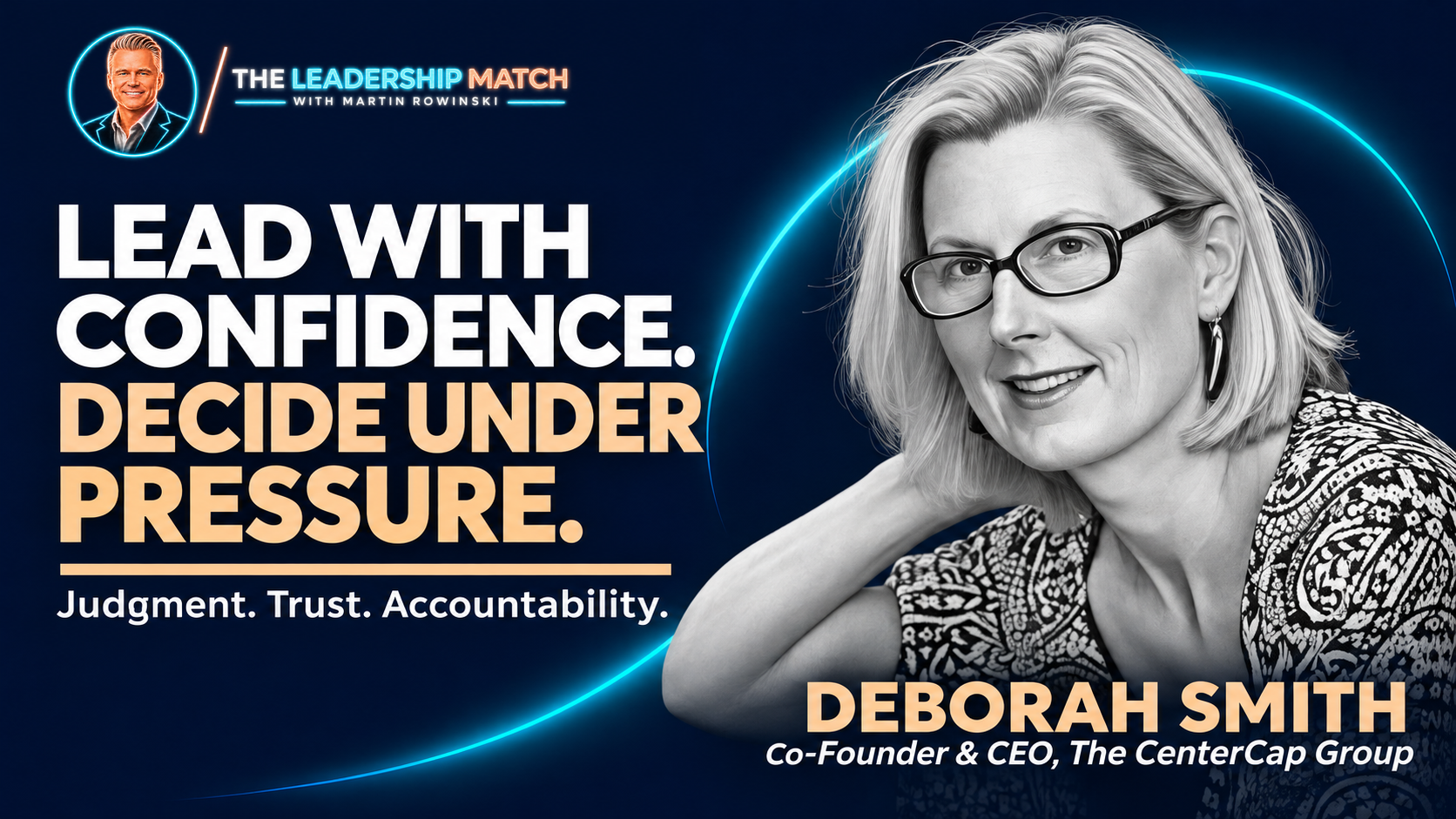
Leadership Decision-Making Under Pressure: Lessons from Deborah Smith By Martin Rowinski | The Leadership Match When the market changes, a strategy stops working, or an unexpected problem lands on your desk, your team needs more than reassurance. They need a decision. That does not mean pretending to have certainty. It means understanding the situation, listening to relevant perspectives, and accepting responsibility for choosing what happens next. In my conversation with Deborah Smith on The Leadership Match, we explored that responsibility through the experience of someone who has advised businesses, worked inside an investment manager, and built a firm of her own. Introduced in the episode as co-founder and CEO of The CenterCap Group, a boutique investment bank focused on real assets, Deborah brought a direct perspective on leadership under pressure. Her career has placed her on different sides of consequential business decisions, including running global M&A at CBRE before helping build her own company. One statement captured her approach: “You can't be a leader if you're not a decision maker.” The challenge is to make decisions that people can trust—and recognize when new information calls for a different direction. What Does Good Decision-Making Under Pressure Require? Leadership decision-making under pressure requires a combination of clear observation, judgment, ownership, and a willingness to adapt. A leader needs to understand what is happening, distinguish evidence from expectation, and decide who is responsible for acting. They also need to remain open to information that challenges the original plan. Deborah described entrepreneurship as an environment where unexpected problems are inevitable. You cannot anticipate every difficulty. You can develop the ability to respond without becoming trapped by how you hoped events would unfold. That creates a useful starting point for leaders facing uncertainty: - What has actually changed? - What do we know, and what remains unclear? - Which assumptions need to be reconsidered? - Who needs to contribute to the decision? - Who is accountable for making it? These questions do not eliminate uncertainty. They help organize it so the team can move forward. Know When Persistence Has Become Attachment to the Plan Entrepreneurs are often encouraged to keep pushing. Persistence matters, but it becomes less useful when it prevents a leader from recognizing that an approach is no longer working. Deborah challenged that instinct directly: “Well, maybe what you're doing isn't right and it's not working, you don't have a market for it.” That is an uncomfortable possibility, particularly when a founder has invested time, money, and personal identity in a strategy. The leadership task is to determine whether the business needs more time to execute—or a meaningful change in direction. A difficult month does not necessarily invalidate a strategy. Equally, commitment alone does not establish that the strategy is sound. A practical application of Deborah’s point is to separate execution problems from underlying assumptions. An execution problem might involve unclear responsibilities, insufficient capacity, or a process that is not being followed. An assumption problem might involve a customer need that is weaker than expected, an offering that does not fit the market, or a business model that depends on conditions that have changed. The response should reflect the diagnosis. Working harder on the same approach may help the first situation while leaving the second unresolved. Adapt Around What You Know How to Do Well Deborah described The CenterCap Group’s development as a series of responses to opportunities rather than the execution of a fully formed master plan. The firm began with M&A advisory work in real estate and investment management. Over time, she explained, it expanded into capital raising, consulting, and a principal investment business. According to Deborah, that evolution helped the firm serve different needs across changing market conditions. The important detail was the connection between those activities. She described staying close to the investment manager and building around capabilities the firm understood. “It's understanding what we're good at and staying around true to that and then figuring how we can branch beyond it.” That offers a useful way to evaluate a potential pivot. Instead of asking only whether an opportunity looks attractive, ask: - Does it address a need we understand? - Which existing capabilities give us a credible starting point? - What new capabilities would we need? - How does it fit the customers and relationships we already serve? - What would we need to learn before making a larger commitment? Adaptation becomes more disciplined when it connects new opportunities with demonstrated strengths. Confidence Can Mean Trusting Your Ability to Respond Deborah co-founded the firm in 2009, following the global financial crisis. During the conversation, we discussed the challenge of launching a women-owned investment bank focused on real estate in that environment. Her description was strikingly practical. An opportunity emerged, the founders took it, and further opportunities followed. She did not portray the beginning as a moment when every future step was clear. Instead, she returned to a phrase that still reflects her approach: “We'll figure it out.” That statement could sound casual without context. In Deborah’s account, it rested on experience, relevant knowledge, and a willingness to act. For leaders, there is a useful distinction between believing a plan cannot fail and believing you can respond intelligently when it needs to change. The second form of confidence leaves room for learning. You can communicate a direction while acknowledging what remains uncertain. You can commit to the next step without claiming to know the entire path. You can explain what would cause you to reconsider. That gives a team something more useful than either overconfidence or indefinite hesitation: a decision they can act on and a basis for reviewing it. Earn Trust by Giving an Honest Assessment Deborah’s approach to advisory work includes telling prospective clients when she believes their expectations do not match the situation. She described being willing to say that a proposed transaction was not ready—and explain what needed to change. That is an important leadership behavior. People often seek advice when they want confidence about an outcome. A trusted advisor must also be willing to identify obstacles. Agreement may make a conversation comfortable. A clear assessment gives the other person something they can use. The same principle applies inside an organization. A leader may need to tell a team that a deadline is unrealistic, a proposal is underdeveloped, or a plan depends on an assumption that has not been tested. The value lies in combining candor with explanation: - State the concern clearly. - Identify the evidence or reasoning behind it. - Explain the implications. - Describe what needs to happen next. - Remain open to information that could change the assessment. Directness is most useful when it helps someone understand and address a problem. Your Most Valuable Supporters May Be Unexpected One of Deborah’s strongest lessons concerned the people who helped the firm develop. She recalled advice she received at the beginning: “The people you thought would help you be successful once you've started, don't show up. And the people you least think will be helpful, they do.” Her experience included advisors, professional partners, clients, and other supporters whom she had not necessarily known before starting the business. The lesson is to pay attention to how relationships develop in practice. A prestigious connection or a long history does not automatically translate into meaningful support. Someone you meet through the work may become a trusted contributor over many years. Deborah also emphasized reciprocity: “If you want a real relationship, you're gonna put in as much work as you take out.” For leaders, that can mean making thoughtful introductions, sharing useful information, recognizing another person’s contribution, and following through when they need your help. It also means staying interested when there is no immediate request to make. Relationships can expand the information and perspective available when a decision becomes difficult. Building them requires attention long before that moment arrives. Trust and Accountability Need to Work Together Deborah connected trust with giving people responsibility and making expectations clear. “If you want the best out of people and you want them to trust you, then you have to trust them to do what you've asked of them.” That trust needs a shared understanding of the work. An employee cannot reliably meet an expectation that has not been explained. A manager cannot meaningfully delegate responsibility while retaining control over every minor choice. A practical delegation conversation should establish four things: The outcome: What needs to be accomplished? The authority: Which decisions can the person make independently? The boundaries: What constraints or situations require escalation? The review: How and when will progress be assessed? This creates room for ownership while preserving accountability. For example, asking someone to “manage the client relationship” leaves substantial ambiguity. Clarifying which commitments they can make, which issues they should escalate, and what a successful relationship looks like makes the responsibility more workable. Trust becomes operational when people know what they own. Examine What Is Driving Micromanagement Deborah identified lack of trust as a reason leaders micromanage. That observation is worth examining before responding with more oversight. If you repeatedly intervene, ask what concern you are trying to address: - Has the person demonstrated a specific skill gap? - Have you made the required standard clear? - Have previous commitments been missed? - Are you uncomfortable with a different but reasonable approach? - Have you given responsibility without the authority needed to carry it out? These situations require different responses. A skill gap may call for coaching. An unclear standard may require a better brief. A pattern of missed commitments may need a direct accountability conversation. Discomfort with someone else’s method may require the leader to step back. The goal is to identify the issue precisely. Constant intervention without explanation can leave both people frustrated while preventing the employee from demonstrating what they can do. Make Learning Part of Your Decision Process When I asked Deborah what leaders could do to improve, she described a daily commitment: “Every day I get up, I focus on learning something new that I didn't know yesterday.” She explained that learning might come from a conversation, a meeting, something she reads, or a question she asks. This connects confidence with continued curiosity. Experience provides a foundation for judgment, but it should not close a leader off from information. A practical habit is to end the day by recording one useful insight: - What did I learn? - Which assumption did it challenge or strengthen? - Does it affect a decision I am making? - Who else would benefit from knowing it? The purpose is to make learning available for action. An insight that never influences a question, a decision, or a behavior has limited practical value. Be Clear About Who Makes the Decision Deborah was equally clear that listening to other perspectives does not remove the need for an accountable decision-maker. “I take in other people's views, but at the end of the day, someone's always in charge.” Teams can lose momentum when consultation becomes an indefinite process. People provide input, alternatives accumulate, and no one is sure who will make the final call. Before a consequential discussion, establish: - Who is making the decision? - Whose input is needed? - What information is necessary? - When does the decision need to be made? - What conditions would justify revisiting it? This is a practical extension of Deborah’s emphasis on ownership. It allows discussion to improve the decision without obscuring responsibility. Delaying can sometimes be appropriate—for example, when essential information will soon be available. But the reason for waiting should be explicit, along with what happens next. A Decision to Improve This Week Choose one decision that has remained unresolved longer than it should. Write down the current situation, the options, and the assumptions behind them. Identify the information that could materially change the choice. Ask the relevant people for their perspective. Then name the decision-maker and agree on a date. Once the decision is made, explain the reasoning, clarify who owns the next steps, and establish when to review progress. This gives the team a direction while preserving the ability to learn and adapt. Leadership Is Proven in the Choices You Own My conversation with Deborah brought together several responsibilities that leaders cannot separate for long: making decisions, recognizing when to change direction, investing in relationships, and trusting people with meaningful work. Confidence helps you act. Learning helps you improve your judgment. Accountability connects the decision to what happens afterward. Deborah closed that idea with a useful distinction: “If you want to be respected and you've been the designated decision maker, then you have to make decisions. If you want the trust, they have to be good ones.” The next time you face pressure, start with the facts. Seek the perspectives that matter. Be honest about what you do not know. Then take responsibility for moving the work forward. Watch or listen to Deborah Smith’s conversation, “How Great Leaders Make Decisions Under Pressure,” on The Leadership Match for more on judgment, resilience, trust, and leading through changing markets.
All articles