Is It a Bad Hire or Poor Delegation When Your Team Can't Deliver? with Karan Kanwar
Karan Kanwar
CEO at Wing Assistant & Central AI
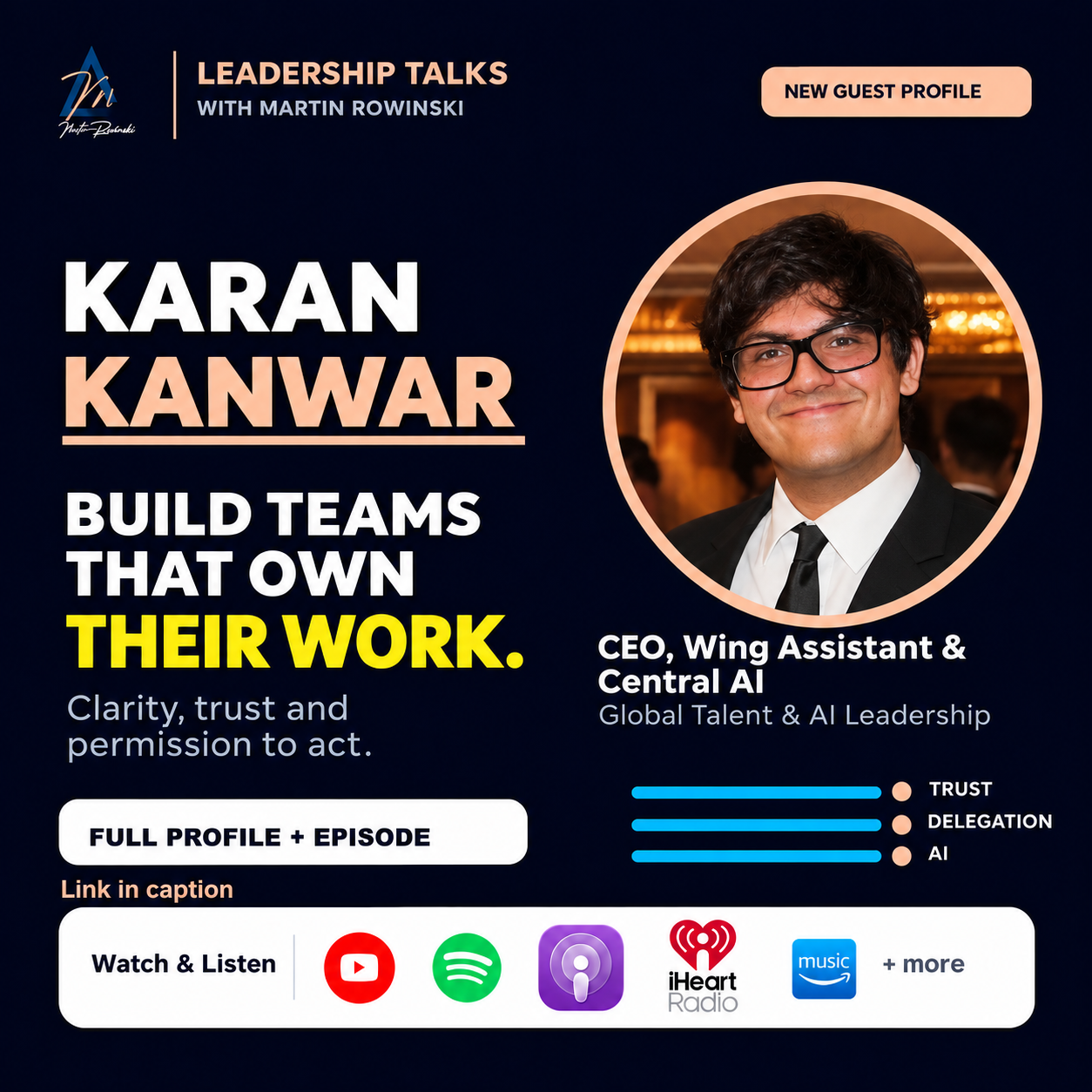
Karan Kanwar is the CEO of Wing Assistant and Central AI, working at the intersection of global talent, artificial intelligence, and business operations. Through Wing Assistant, he helps businesses build teams with remote professionals. At Central AI, he leads the development of AI agents designed to support business workflows and customer interactions. Raised in Hong Kong and now based in San Francisco, Karan discovered programming at eight after helping a teacher create a hyperlink in Microsoft Word. His curiosity led him to an online HTML tutorial, then to building websites. What began as a classroom task became a lasting interest in how technology works and what it can make possible. His background spans artificial intelligence, machine learning, full-stack software development, and cloud technologies. Before leading Wing and Central AI, he worked with organizations including Morgan Stanley, Goldman Sachs, Barnes & Noble, and Technossus, and consulted for more than 40 businesses across several industries and regions. Karan brings both technical and operational experience to leadership. His approach emphasizes clear expectations, advancement based on contribution, and giving people the resources and authority to succeed. Across his two companies, he explores where human talent, AI agents, or a combination of both can best serve customers. Show Description What happens when a founder can do the work faster than the people they hire? For Karan Kanwar, learning to lead meant questioning whether doing everything himself was helping the business grow or holding it back. In this episode of The Leadership Match, Martin Rowinski sits down with the CEO of Wing Assistant and Central AI to explore the experiences behind his approach to leadership. Karan shares how a childhood discovery of coding became a career in technology, how working at Morgan Stanley changed his understanding of culture, and why witnessing favoritism influenced the way he evaluates talent. He also tells the story of Wing’s evolution from a consumer concierge service into a business-focused talent company. A customer’s question prompted a pivot that helped the team recognize a stronger opportunity. The conversation moves into the practical challenges of building teams: letting go of work you know how to do, distinguishing poor hiring from unclear expectations, and recognizing when capable employees lack the confidence or permission to act. Karan also candidly discusses his own difficulty with direct feedback and what leading a newer company has revealed about that challenge. Finally, Martin and Karan examine how customer trust shapes the choice between human support and AI agents. Karan explains Central AI’s emphasis on defining workflows carefully and testing scenarios before deployment. His closing advice gives leaders a useful place to start: find out what is preventing your people from doing their best work, including barriers that additional tools or budget will not resolve.
Key takeaways
- Being faster at a task does not make it the best use of a founder’s time. Karan encourages leaders to examine whether they are moving the organization forward or taking back work because they can complete it more quickly.
- A working demo and a complete product are different responsibilities. He recalls building quickly himself while overlooking less visible requirements, such as notifications and authentication, that his engineering team needed to address.
- Clarify the assignment before blaming the hire. Before deciding someone is underperforming, examine the workload, training, expectations, and support. Karan describes narrowing responsibilities back to the person’s core role and using regular check-ins to assess performance more fairly.
- Strong performance depends on the environment as well as the individual. Someone who thrives in an early-stage team may struggle in a more structured setting. Pace, responsibilities, and expectations affect the fit.
- Culture includes who gets the opportunity to advance. After witnessing favoritism, Karan wanted contribution to matter whether an employee was outspoken, quiet, social, or introverted.
- Recognizing a problem is different from addressing it clearly. Karan shares how insufficiently direct communication has allowed issues to persist and why respectful, specific feedback remains an area of personal growth.
- AI adoption depends on trust and the use case. Karan describes customer willingness as an important factor in deciding where to deploy people, AI agents, or both. He emphasizes clear boundaries and repeated scenario testing.
- Permission can be as important as resources. An employee may have the skills and tools to improve something but still fear overstepping. Leaders need to ask what people feel unable to change and clarify their authority.